


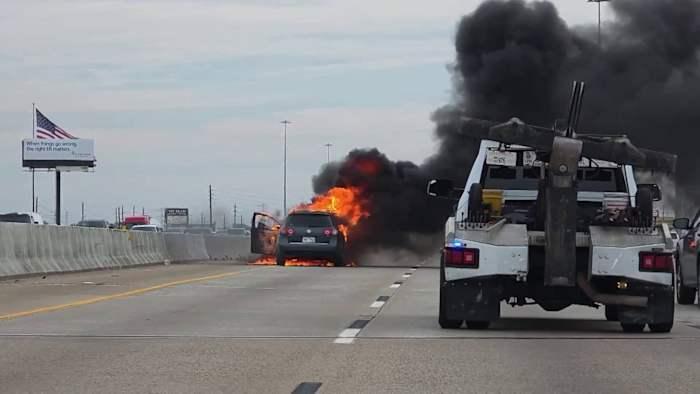
HOUSTON: A vehicle fire on IH-69 Southwest at Main has once again highlighted a situation Houston drivers regularly face: a sudden freeway emergency that can bring traffic to a complete stop and force thousands of motorists to change their route with little warning.
The northbound roadway was closed because of the fire, with drivers advised to avoid the area and use alternate routes.
For drivers, however, the bigger question is not simply “Which road should I take?”
It is: What should I do when I suddenly find myself in traffic near a vehicle fire, crash or major freeway closure?
For Houston’s Pakistani-American community, understanding these basic steps can be especially useful. Houston’s extensive freeway network means a relatively small incident can quickly create long backups, while emergency vehicles need clear access to reach the scene.

First: Slow down and give the emergency area space
If you see smoke, flames, a crash or emergency vehicles ahead, reduce your speed and remain in your lane unless it is safe and necessary to move.
Do not stop unnecessarily to watch or record the incident.
A vehicle fire can produce thick smoke and reduce visibility. Burning vehicles may also contain fuel, batteries, tires, plastics and other materials that can create hazardous smoke.
If you are close enough to see flames or heavy smoke, increase the distance between your vehicle and the incident.
Never drive around emergency vehicles
One of the most important rules during a freeway emergency is to give first responders room.
Houston-area drivers may encounter police vehicles, fire trucks, ambulances and tow trucks around an incident.
Move over when required and when it is safe to do so. Do not drive onto the shoulder simply to get past traffic unless directed by law enforcement.
Emergency crews may need to move quickly in either direction.
A few extra minutes of delay is far safer than interfering with emergency operations.
What if traffic suddenly stops?
This is where many secondary crashes can happen.
If traffic comes to a sudden stop:
- Slow down gradually.
- Leave space between your vehicle and the car ahead.
- Watch your mirrors for approaching traffic.
- Avoid sudden lane changes.
- Keep your attention on the road rather than your phone.
- Follow instructions from police or highway officials.
If you are already trapped in a traffic backup, remain patient. Trying to make an aggressive U-turn, driving against traffic or using an unauthorized shoulder can create a much more dangerous situation.
If your vehicle is near a fire
If flames or heavy smoke are coming from another vehicle, do not approach it.
If you are able to safely move away from the scene, do so.
If your own vehicle catches fire, pull over as soon as it is safe, turn off the engine and get everyone out.
Once outside, move away from the vehicle and do not return for belongings.
Call 911 and give the dispatcher your location, direction of travel and any identifying information you can provide.
Do not attempt to open the hood or investigate the fire yourself.
Don’t depend only on Google Maps
During a major crash or fire, navigation apps can sometimes continue directing drivers toward congested areas or roads affected by an incident.
Before leaving home — particularly during busy travel periods — check official traffic information.
Houston TranStar provides real-time information about freeway incidents, closures and road conditions.
Drivers can check:
traffic.houstontranstar.org/roadclosures/
If officials are telling drivers to avoid an area, don’t try to find a shortcut through the incident zone.
Keep an emergency kit in your car
A freeway emergency can leave drivers sitting in traffic for much longer than expected.
Houston drivers should consider keeping a basic emergency kit in their vehicle, including:
- Drinking water
- Phone charging cable or power bank
- First-aid supplies
- Flashlight
- Reflective warning device
- Basic medications
- Jumper cables or a portable jump starter
- Emergency contact information
For Houston families, water is particularly important during hot weather. A traffic backup that lasts for hours can become a heat-related safety issue, especially for children, older adults and people with medical conditions.
What Pakistani families should teach teenagers
Many Pakistani-American families have teenagers who drive independently or are learning to drive.
One important lesson is that a freeway emergency is not a time to stop and watch.
Young drivers should know how to:
- Recognize emergency vehicles and flashing lights.
- Slow down when approaching a crash.
- Keep a safe distance.
- Follow police instructions.
- Avoid using their phone while driving.
- Know how to call 911 and explain their location.
- Understand that an alternate route may be safer than trying to get around a closure.
Parents can also show teenagers how to identify the freeway name, direction of travel and nearest exit. Those details can make it much easier for emergency dispatchers to locate a driver who needs help.
A freeway closure is more than a traffic problem
The IH-69 incident is a reminder that Houston’s transportation emergencies can quickly become safety emergencies.
A vehicle fire can lead to road closures, smoke, secondary crashes, emergency-response delays and long traffic backups.
The safest response is therefore simple:
Slow down. Create distance. Follow official instructions. Give emergency crews room. And leave the area when authorities advise you to do so.
For Houston’s Pakistani-American community, knowing these basic steps can turn a confusing freeway emergency into a manageable situation

