


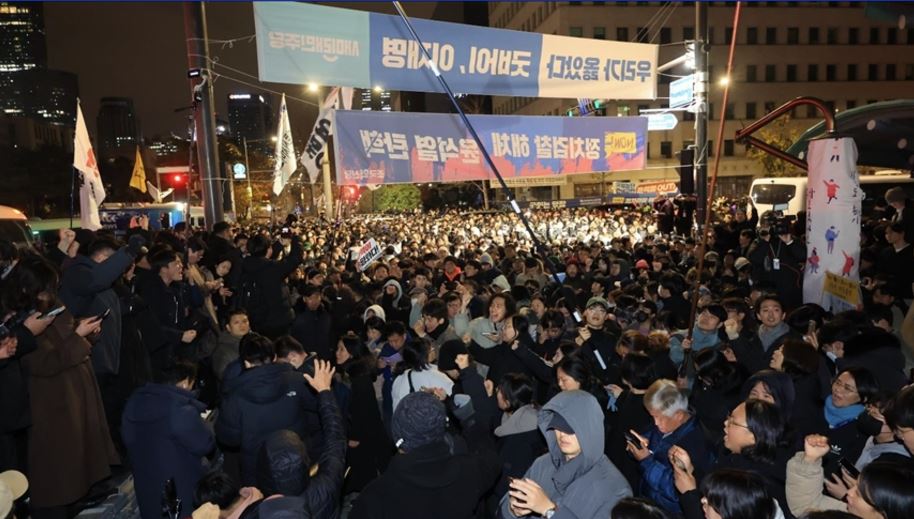
South Korea’s parliament has passed a bill nullifying President Yoon Suk-yeol’s declaration of martial law, a move seen as a major assertion of legislative authority. The resolution, supported by 190 of the 300 members, renders martial law ineffective under South Korean law, which mandates the president to lift such measures following a parliamentary vote.
Soldiers Withdraw as Martial Law Faces Legal Challenge
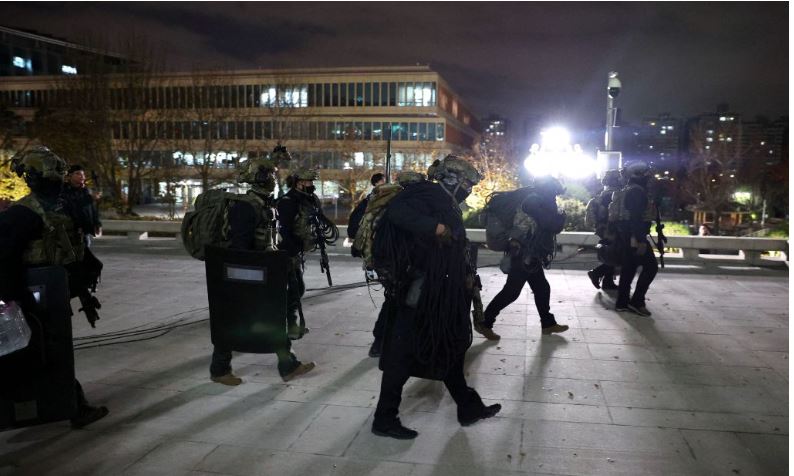
Reports from American media indicate that soldiers, who had entered the main parliamentary building after the bill’s passage, began retreating, while some remain stationed outside, awaiting further instructions. Despite the parliamentary vote, the South Korean military insists martial law remains in effect until officially rescinded by the president.
Nationwide Protests Erupt Against Martial Law
President Yoon’s declaration of martial law during a late-night address, citing a need to eliminate “anti-state forces,” has sparked widespread public outcry. Protesters have gathered outside the National Assembly, demanding an immediate end to martial law. Live broadcasts captured dramatic scenes of soldiers attempting to storm the parliamentary building, with aides using fire extinguishers to hold them back.
Martial Law Restrictions and Historical Context
Under martial law, the military has restricted political and parliamentary activities, placing media and publishing under its control. This marks the first declaration of martial law in South Korea since 1980, a stark reminder of the country’s authoritarian past before transitioning to democracy in the 1980s.
Read more from Pulse News:https://pulsenews.world/south-korea-president-yoon-declares-martial-law/
Opposition and International Concerns
Prominent opposition leaders, including Lee Jae-ming of the Democratic Party, have condemned the president’s actions as unconstitutional. Lee pledged to uphold the constitutional order and protect the National Assembly, even at great personal risk. Former President Moon Jae-in voiced grave concerns about the country’s democracy, urging swift parliamentary action to safeguard its integrity.

Meanwhile, the White House has expressed concern, stating it is closely monitoring the situation and maintaining contact with South Korean authorities. The presence of 28,500 US troops in South Korea underscores the geopolitical sensitivity of the crisis.
The Road Ahead
As tensions escalate, South Korea faces a pivotal moment. The resolution passed by parliament is a significant step in challenging the president’s actions, but the outcome will depend on whether President Yoon complies and withdraws martial law, ensuring the preservation of democratic governance.

