


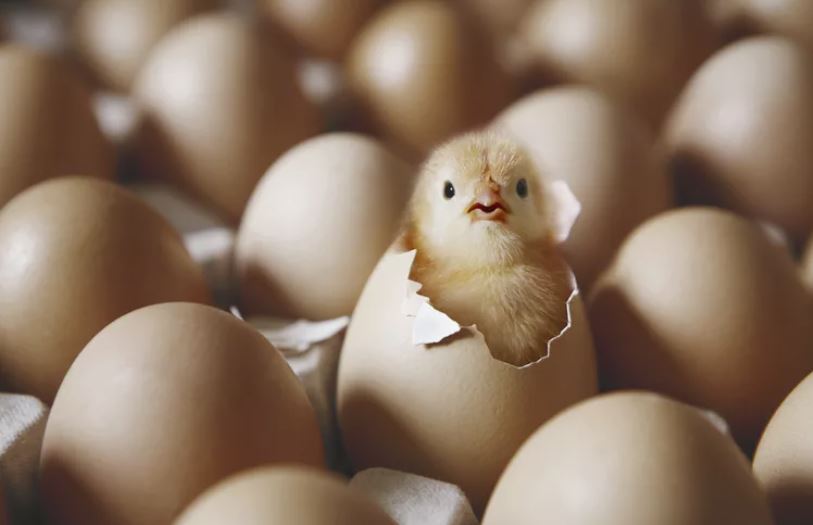
For centuries, the age-old question of whether the chicken or the egg came first has baffled thinkers. Now, scientists may have solved the mystery, revealing that nature had the tools to create eggs long before chickens ever existed, according to a new study.
The Evolutionary Puzzle: How Life Evolved
It is widely believed that the first life forms on Earth were single-celled organisms, which gradually evolved into more complex beings. However, the exact process of this evolution has remained unclear.
A research team from the University of Geneva sought to shed light on this question by studying Chromosphaera perkinsii, a single-celled species discovered in 2017 in marine sediments near Hawaii. This organism split off from the animal evolutionary line over a billion years ago, making it an ideal subject to explore the early steps toward multicellularity—the development of life forms made up of multiple cells.
Uncovering Early Multicellular Traits in a Single-Celled Organism
The researchers found that C. perkinsii does something surprising: once it reaches its maximum size, it divides without further growth, forming multicellular colonies that take on a three-dimensional structure. These structures resemble the early stages of animal embryonic development.

This discovery suggests that embryonic development, a key feature of animals, may have existed before animals themselves—essentially proving that the egg came before the chicken. The multicellular colonies persist for about a third of their life cycle and contain at least two distinct cell types, a “surprising phenomenon” for a single-celled organism. This indicates that the mechanisms for complex multicellular development were in place more than a billion years ago, long before the emergence of animals.
A Breakthrough in Evolutionary Biology
“This discovery is fascinating, as it allows us to look back over a billion years in time,” said Marine Olivetta, laboratory technician at the Department of Biochemistry at the University of Geneva and first author of the study.
Olivetta explained that the study suggests either embryonic development existed before the appearance of animals, or that C. perkinsii developed mechanisms for multicellular coordination independently.
Omaya Dudin, the lead researcher, noted, “Although C. perkinsii is a unicellular species, its behavior shows that processes of multicellular coordination and differentiation were already in place long before the first animals appeared on Earth.”

