


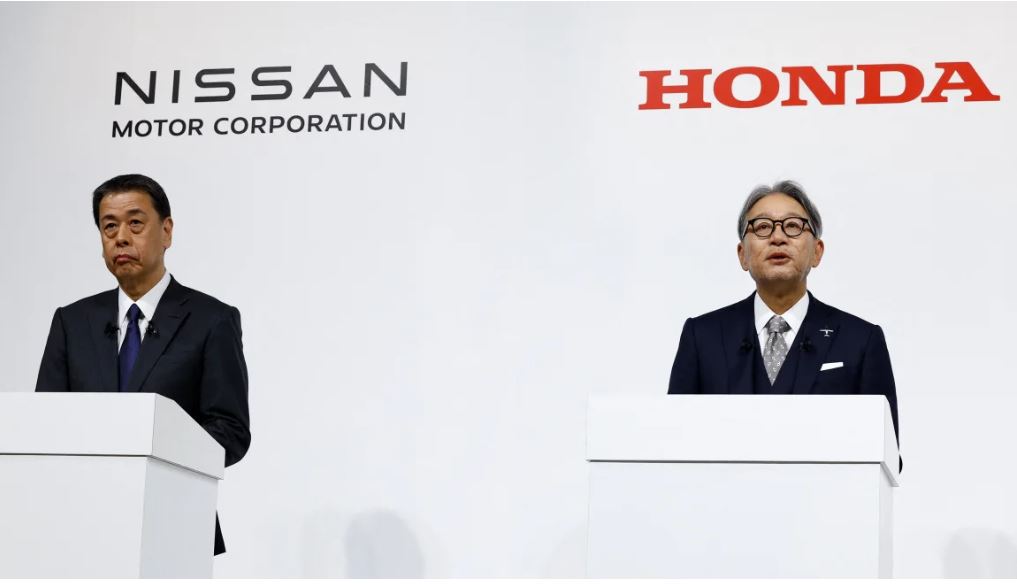
Japanese automakers Honda and Nissan have initiated talks to merge, forming the world’s third-largest automaker by sales. The two companies signed a memorandum of understanding on Monday, with Mitsubishi Motors, a smaller member of the Nissan alliance, also agreeing to participate in discussions regarding the integration of their operations.
Plans for a Joint Holding Company
Honda’s President, Toshihiro Mibe, revealed that both companies plan to unify their operations under a joint holding company, with Honda initially leading the new management. Each company’s brands and principles will be preserved. A formal merger agreement is expected by June, with completion projected for August 2026. Mibe acknowledged that discussions are still in the early stages, and the possibility of the merger not proceeding is still present.
Challenges in the Electric Vehicle Race
Japanese automakers have struggled to keep up with global competitors in the electric vehicle (EV) market. In an effort to stay competitive, Honda and Nissan are looking to cut costs and make up for lost time, with discussions about closer collaboration beginning earlier this year.
Potential for a $50 Billion Merger
If the merger moves forward, it could create a powerhouse valued at over $50 billion, combining the strengths of Honda, Nissan, and the Renault-Nissan-Mitsubishi alliance. The combined entity would compete with major players like Toyota and Volkswagen, though Toyota would remain the largest Japanese automaker even after the merger.
Joint Efforts in EVs and Autonomous Vehicles
Honda, Nissan, and Mitsubishi have already announced plans to share EV components, including batteries, and collaborate on autonomous driving software. This joint effort reflects the need to adapt to the ongoing transformation of the automotive industry, particularly with the growing shift toward electrification.
Honda’s Role in Nissan’s Recovery
Honda is considered the most likely partner to assist in Nissan’s recovery, following the company’s struggles since the 2018 scandal involving former Chairman Carlos Ghosn. The merger could provide Nissan with access to Honda’s truck-based SUVs and hybrid technology, while Honda could benefit from Nissan’s experience in building batteries and EVs.

Nissan’s Financial Struggles and Restructuring
Despite efforts to cut costs, Nissan recently announced plans to slash 9,000 jobs and reduce its global production capacity by 20%. The company also faced a quarterly loss of ¥9.3 billion ($61 million) and has seen its credit outlook downgraded. However, Nissan maintains strong financial reserves and expects the merger to deliver greater value to a broader customer base.
Stock Market Response and Industry Consolidation
Following news of the merger talks, Nissan’s stock price rose by 1.6%, while Honda’s shares surged 3.8%. This merger proposal is part of a broader trend in the automotive industry, with consolidation becoming increasingly important as automakers seek to stay competitive in the rapidly evolving market.
Japanese Government’s Position on Industry Changes
Japanese Cabinet Secretary Yoshimasa Hayashi refrained from commenting on the details of the merger plans but emphasized the need for Japanese companies to remain competitive in the face of global industry shifts, particularly with growing competition in battery technology and software development.

