


NASA to Launch Europa Clipper on Five-Year Journey
An imposing NASA probe is set to launch on Monday, embarking on a five-and-a-half-year journey to Europa, one of Jupiter’s moons. The mission aims to take the first detailed step toward determining if any location within the solar system could support life beyond Earth.
Europa: A Potential Haven for Life?
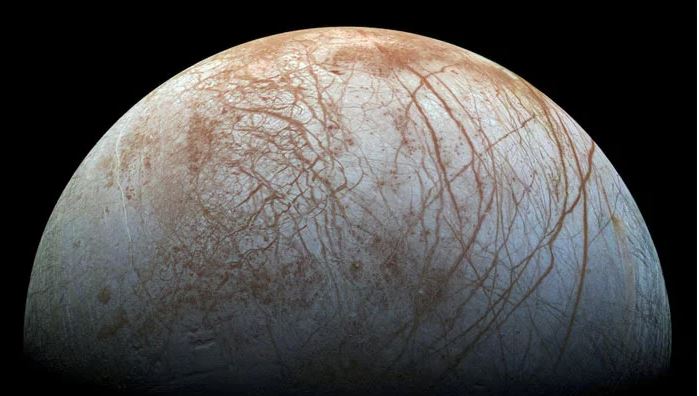
Europa, long thought to contain a vast ocean beneath its icy crust, is considered one of the most promising places to search for life in the solar system. NASA’s Europa Clipper will not seek direct evidence of life, but it will analyze whether the conditions necessary for life—water, energy, and essential chemicals—are present.
“It’s a chance to explore not just a world that might have been habitable billions of years ago, but a world that might be habitable today,” said Curt Niebur, Europa Clipper programme scientist.
Liftoff Scheduled from Cape Canaveral

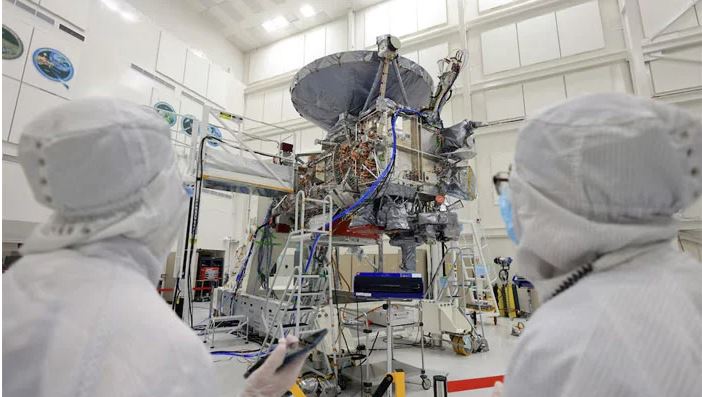
The launch, set for “no earlier than” Monday, will take place from Cape Canaveral, Florida, aboard a powerful SpaceX Falcon Heavy rocket. The probe will carry a range of sophisticated instruments to examine the moon’s icy surface and the potential ocean beneath.
Unveiling Europa’s Mysteries
Europa was first discovered in 1610, but the Voyager probes in 1979 provided the first close-up images of the moon’s mysterious surface, crisscrossed with reddish lines. Later, NASA’s Galileo probe in the 1990s found compelling evidence of a subsurface ocean.
Now, the Europa Clipper will use cameras, radar, a spectrograph, and a magnetometer to study Europa’s surface, its ocean’s salinity, and how the ocean and ice interact. If life exists, it could be in the form of primitive bacteria deep in the ocean, according to Bonnie Buratti, the mission’s deputy project scientist.
Though Clipper may not directly detect such life, it will lay the groundwork for future missions to explore Europa further and search for evidence of life.

