



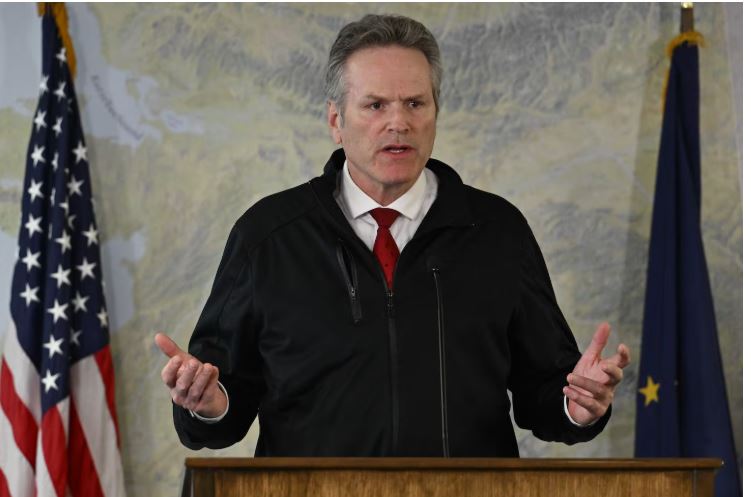
Amid a prolonged U.S. government shutdown that has halted federal food assistance, Alaska Governor Mike Dunleavy on Monday issued a state disaster declaration to provide temporary relief to residents.
Funding for the Supplemental Nutrition Assistance Program (SNAP) remains frozen due to political gridlock in Congress between Republicans and Democrats over federal spending. As a result, millions of Americans, including more than 66,000 Alaskans, were at risk of losing food aid this month.
President Donald Trump declined to use federal emergency funds to continue the program through November, though the administration later said it would partially restore funding following two court rulings. The Associated Press reported that it remains unclear when those funds will reach beneficiaries.
Initially, Dunleavy stated that Alaska could not use state resources to replace the halted federal aid. His administration noted that no funds had been identified to assist food banks, and that the state could not issue aid through the Electronic Benefit Transfer (EBT) cards used for SNAP.
However, by Monday, the governor’s office announced that it had found a way to move forward. The state will work with the federal contractor managing EBT cards to begin weekly deposits of state funds starting this week. The Department of Health will also coordinate with food banks to make sure that Alaskans in need receive support during the shutdown.
“Our goal is to do our best until the federal government resolves the funding issue and things return to normal,” Dunleavy said during a visit to Bethel, where he was assessing storm recovery progress.

The governor’s decision followed mounting pressure from lawmakers who urged him to take immediate action to ensure that SNAP beneficiaries did not go hungry. House Speaker Bryce Edgmon and Senate President Gary Stevens supported the move, emphasizing bipartisan cooperation during a time of crisis. Stevens stated that “Alaskans shouldn’t have to worry about feeding their families because of a federal stalemate.”
The 30-day disaster declaration allows the governor to access money from the state’s Disaster Relief Fund. However, the fund is nearly depleted, as it was recently used for storm recovery in Western Alaska. Monthly food benefits for Alaskans amount to over $20 million, or about $5 million per week.
Earlier this year, Dunleavy vetoed $10 million that lawmakers had allocated for the Disaster Relief Fund, citing reduced state revenue. To fill the current gap, he is redirecting $10 million originally intended for the Village Safe Water and Wastewater Infrastructure program. He plans to request supplemental funding in January’s legislative session to restore those infrastructure funds.
The Village Safe Water and Wastewater program relies on federal funds matched by the state. If lawmakers fail to replenish the state’s contribution, tens of millions of federal dollars for rural projects could be at risk.
Lawmakers had considered calling a special session to authorize new spending, but after Dunleavy’s disaster declaration, both Edgmon and Stevens agreed that such a session was unnecessary.
The total cost of replacing federal food aid will depend on the length of the shutdown. Dunleavy estimated that Alaska’s weekly cost could range from $2.5 million to $5 million, depending on whether the Trump administration’s partial funding becomes available.

