


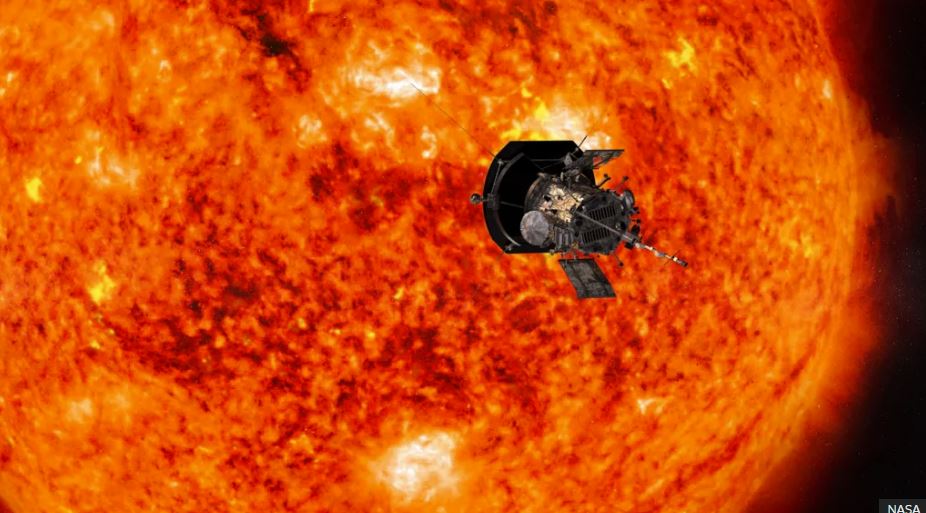
A NASA spacecraft has achieved a groundbreaking milestone by surviving the closest-ever approach to the Sun. The Parker Solar Probe successfully sent a signal to scientists just before midnight EST on Thursday (05:00 GMT Friday), following several days of radio silence during its perilous journey near the Sun.
NASA confirmed that the spacecraft was “safe” and operating normally after flying within just 3.8 million miles (6.1 million km) of the Sun’s surface. This incredible feat occurred on Christmas Eve, as the probe ventured into the Sun’s outer atmosphere, enduring searing temperatures and intense radiation.
Record-Breaking Close Encounter
Traveling at speeds of up to 430,000 mph (692,000 kph), Parker Solar Probe endured temperatures reaching 1,800F (980C). This mission aims to deepen our understanding of the Sun’s processes, including how its outer atmosphere, or corona, heats up to millions of degrees and how solar wind is generated.
NASA’s statement highlighted, “This close-up study of the Sun allows Parker Solar Probe to take measurements that help scientists better understand how material in this region gets heated to millions of degrees, trace the origin of the solar wind, and discover how energetic particles are accelerated to near light speed.”
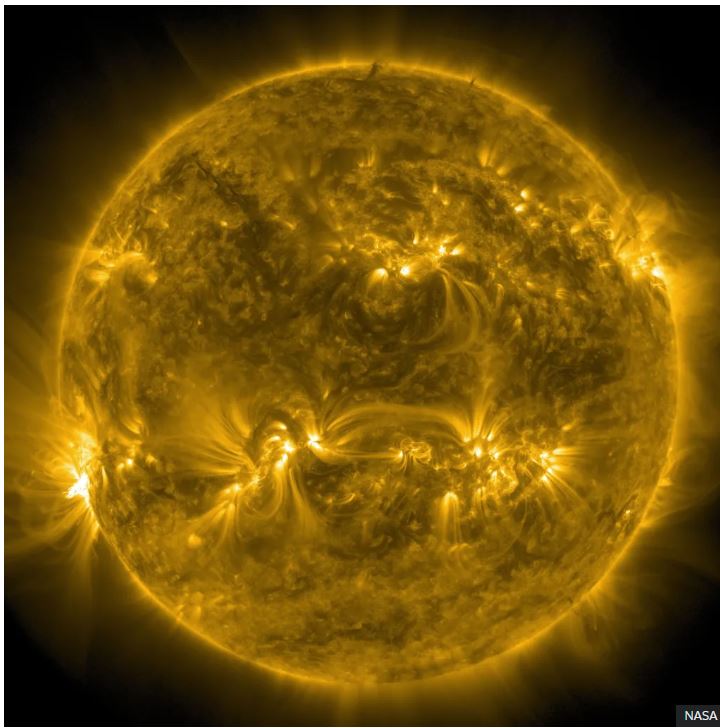
Unprecedented Exploration of the Solar Atmosphere
Dr. Nicola Fox, head of NASA’s science division, remarked, “For centuries, people have studied the Sun, but you don’t experience the atmosphere of a place until you actually go and visit it. We can’t truly experience the atmosphere of our star unless we fly through it.”
Launched in 2018, the Parker Solar Probe has already completed 21 flybys of the Sun, each getting progressively closer. Its Christmas Eve maneuver set a new record, coming within just 3.8 million miles of the solar surface.

Putting the Distance into Perspective
Although 3.8 million miles might seem far, Dr. Fox explained its significance. “We are 93 million miles away from the Sun. If the Sun and Earth were one meter apart, Parker Solar Probe would be just 4 centimeters from the Sun — that’s close.”
To survive, the probe’s instruments were protected by an 11.5 cm (4.5 in) thick carbon-composite shield. The spacecraft’s strategy was speed: moving faster than any human-made object, Parker’s velocity allowed it to traverse the distance from London to New York in less than 30 seconds.
Unraveling Mysteries of the Corona
Scientists hope the data collected during this mission will help solve a long-standing solar mystery: why the corona, the Sun’s tenuous outer atmosphere, is much hotter than its surface.
Dr. Jenifer Millard, an astronomer at Fifth Star Labs in Wales, explained, “The surface of the Sun is about 6,000°C, but the corona reaches millions of degrees, even though it’s farther away from the Sun. How is that atmosphere getting hotter?”
The Importance of Understanding Solar Wind
The mission also seeks to provide insights into solar wind, a continuous stream of charged particles escaping the corona. This solar wind interacts with Earth’s magnetic field, creating stunning auroras but also causing disruptions to power grids, electronics, and communication systems.
“Understanding the Sun, its activity, space weather, and the solar wind is crucial to our everyday lives on Earth,” said Dr. Millard.
A Nail-Biting Wait
During the probe’s solar flyby, NASA scientists faced a tense wait for confirmation of its status. Dr. Fox revealed she expected a green heart emoji from her team to signal the spacecraft’s safety. Despite the nerve-wracking nature of the mission, Dr. Fox expressed confidence in the spacecraft’s robust design.
“I will always worry about the spacecraft,” she admitted, “but we have designed it to withstand these brutal conditions. It’s a tough, tough little spacecraft.”

